
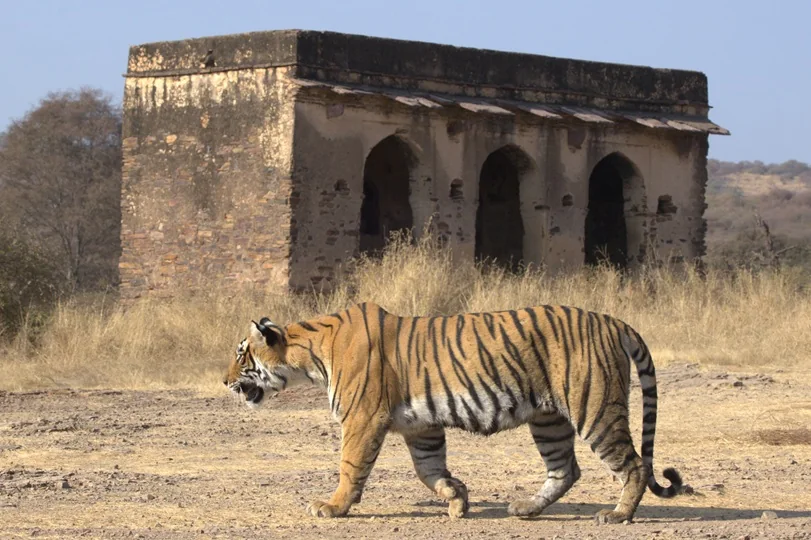
A Tiger’s Citadel: Ranthambore
Though it needs no introduction, Ranthambore surprised me in ways I cannot express.
The charming Pink City had already given me a taste of the famed hospitality of Rajasthan, a name that literally means “Land of the Kings.” Back in the day, Ranthambore itself was part of the royal estates of Jaipur.
The park is in the district of Sawai Madhopur, a place unfamiliar to many, like me. But Ranthambore? Hardly anyone visiting Rajasthan has not heard of it.
I took a cab from the busy capital, Jaipur, to the tiger city. The journey truly reflected the famous saying: “In India, everything changes every 10 miles: culture, language, landscape.”
For someone like me, born and brought up in the countryside, it felt like coming home.
The Ranthambore Safari Experience
Two types of vehicle go into the park:
- Gypsy: a six-seater open jeep
- Canter: a 20-seater open bus
Both are sturdy enough for the rugged terrain. Visitors can choose either, and I opted for the Gypsy for a more intimate experience of the wild.
The park is divided into 10 zones, and each safari slot lets you explore one of them.
A Moment of Magic
I would call Ranthambore a “chatter city”, only here, unlike urban gossip, the conversations are all about tigers: who is on the move, who has made a kill, and where a particular tiger might appear next. That constant buzz only added to the thrill.
I was lucky to be assigned Zone 3, one of the premium zones. From the moment we entered the forest, I could feel the jungle. The earthy smell, the langurs going about their day, the ancient ruins: it all felt like stepping into another world.
Serene lakes with a majestic fort in the background added to the surreal beauty.
I loved observing the habitat, the prey animals, and the untouched wilderness. But at the back of my mind, I was waiting for that one unforgettable moment, the tiger sighting.
As we passed Rajbagh Lake, we heard intense alarm calls. My adrenaline spiked. The guide pointed silently, and there she was: Arrowhead, the Queen of the Lakes.
And in that fleeting, magical moment, she looked me straight in the eye.
It is impossible to describe that feeling of awe, humility, and sheer connection. As I said, some experiences simply cannot be explained.
History in the Hills: A Visit to Ranthambore Fort
My deep interest in history took me on an excursion to Ranthambore Fort, a UNESCO World Heritage Site.
Religion, spirituality, and heritage are deeply intertwined in this majestic hilltop fort. You can feel the echoes of past rulers, ancient legends, and diverse faiths as you explore.
One striking aspect is the presence of temples of several faiths, a sign of the fort’s historical and cultural diversity.
I tried to imagine its glory days, with royal banquets at Badal Mahal and the jungle forming a breathtaking backdrop.
The fort is still very much alive today. Locals often visit the famous three-eyed Lord Ganesha temple, which, in my experience, is the most important place of worship in the area.
That blend of living tradition and ancient ruins makes the fort more than just a historical landmark.
Safari Tips: How to Make the Most of Ranthambore
- Book in advance: especially for Gypsy slots. Aim for at least a month ahead.
- Choose early-morning safaris: they offer a better chance of spotting big cats.
- Carry valid ID: it is mandatory for entry into the park.
- Follow the rules: no loud noises, no feeding animals, and no littering. Respect the wild.
- Pack smart: bring binoculars and a good camera. You will thank yourself later.
Final Thoughts: More Than Just Tigers
The tiger is undoubtedly the star of Ranthambore, but the park is teeming with life and stories.
From leopards, sloth bears, and marsh crocodiles to hundreds of bird species, it is a biodiversity hotspot, steeped in myth, history, and raw adventure.
Ranthambore is a feeling.
One that lingers long after you have left the forest behind.